
Bleems S.P.C.
completedProject Brief
Checkout was the largest leak in the Bleems funnel. Historical analytics showed a sharp drop in add-to-cart conversion at the checkout stage. The drop was concentrated among first-time customers arriving from marketing campaigns, the traffic we were paying the most to acquire.
I led the discovery work to understand why. Customer interviews pointed to the structure of the page rather than any single field. One long checkout page asked people to personalize a gift, sort out delivery and pay, all at once and with no sense of progress. For a gifting product it also ignored the most common blocker of all: the sender often does not know the recipient's address.
I framed the work around two outcomes. For customers, a checkout that follows the way people actually think about sending a gift. For the business, less friction between product and payment, plus a gifting feature competitors did not offer. We set a target of a 7% lift in add-to-cart conversion and delivered close to 16%.
Scope of Work
Rather than polishing the existing page, we rebuilt the flow around the order of decisions a gift sender makes.
A three-stage structure
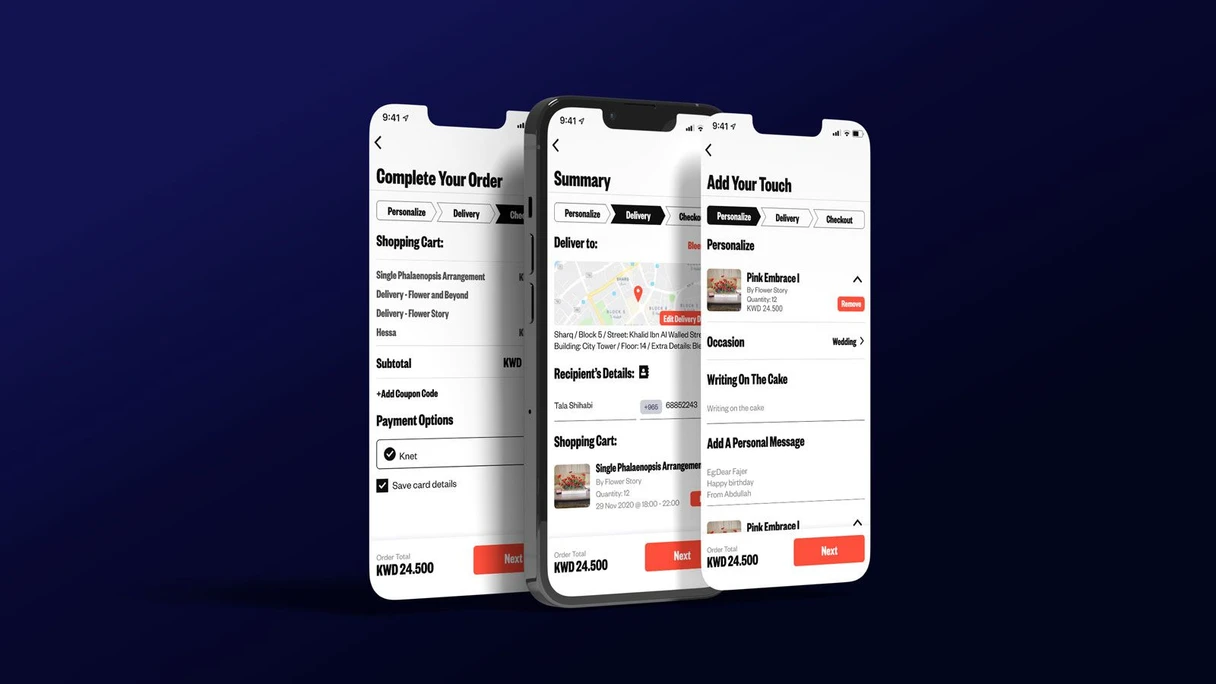
The single page became three stages: Personalization, Delivery and Payment. Each stage asks for one kind of decision and has a clear progress indicator and a single primary action, so customers always know where they are and what comes next.
Personalization first
Card messages, toppers and accessories moved to the start of the flow. Leading with the emotional part of gifting keeps customers invested before any logistics appear, and it puts add-ons where they matter most, not at the end as an afterthought.
Solving the unknown address
The "I don't know the address" option lets a sender provide only the recipient's name and phone number. Our team then retrieves the address privately. This removed a hard blocker for gifting orders, protected the recipient's privacy and gave Bleems a clear point of difference. Because the address is resolved after the order is placed, the feature was designed as a service, not just a screen.
Context-aware payment
Payment methods adapt to device and location: Apple Pay on iOS, Google Pay on Android and KNET for customers in Kuwait. Leading with the most relevant method removes a decision at the point where hesitation costs the most.
Project Details
The redesign changed both how checkout felt and how it performed.
Customer impact
- Splitting checkout into stages removed the feeling of facing one long, cluttered form.
- Address retrieval and context-aware payment let customers stay focused on the gift rather than the logistics.
Business impact
- Add-to-cart conversion rose by close to 16%, more than double the 7% target.
- The "I don't know the address" option became a clear differentiator. It drew positive customer feedback and reduced drop-off on a well-known gifting pain point.
- Adaptive payment reduced friction at the final step, with the clearest gains on mobile, where completion rates rose.
What made the difference
Analytics showed where customers were leaving, and interviews explained why. The gains came from treating checkout as a sequence of decisions, and from treating the unknown address as a service problem rather than a form field, not from visual polish.
Project Gallery