
Personal Project
completedProject Brief
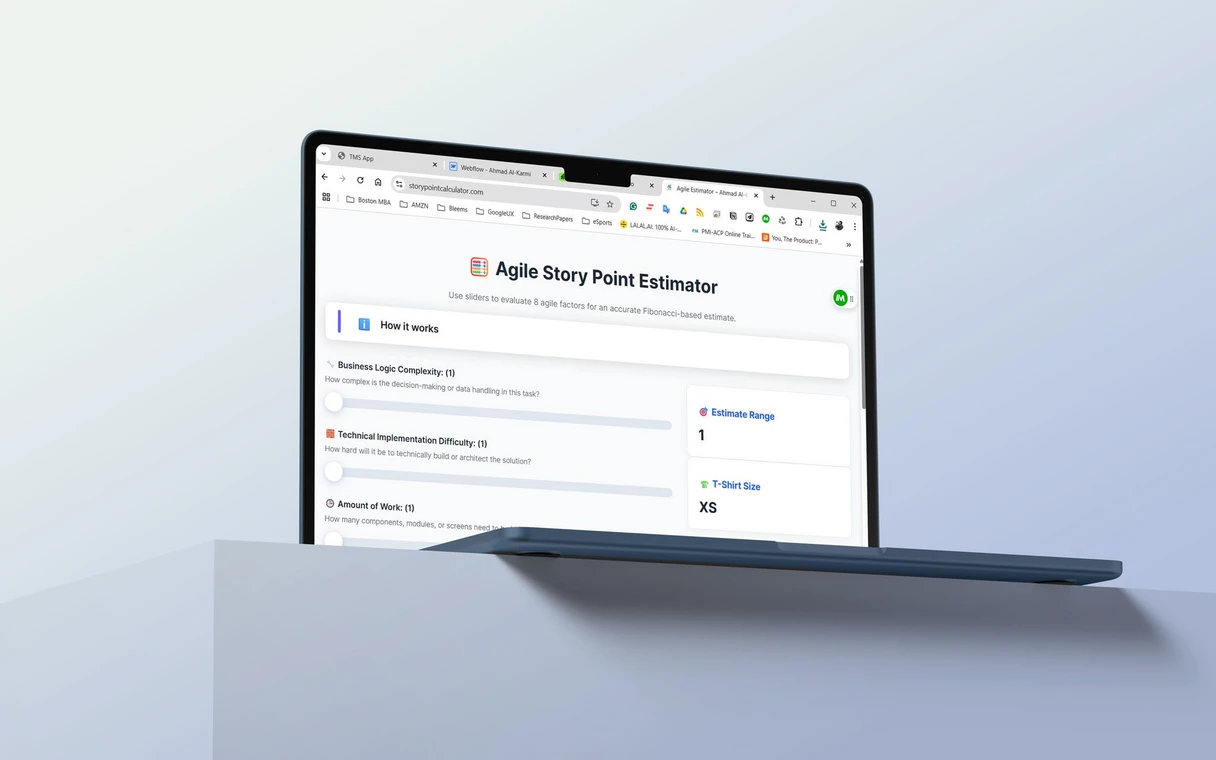
I took it upon myself to vibe-code my way to a tool that I could use on a daily basis. The Story Points Calculator is a Progressive Web App (PWA) designed to assist Agile development teams in estimating story points during planning poker sessions. This tool provides a structured approach to breaking down and evaluating user stories based on multiple complexity factors. I also use this tool as a product manager to pre-plan my roadmap for the coming cycles. I apply the same general questions to product features when asking developers from a high level about the features I want to build and it significantly helps me plan the cycle ahead. Visit Now
Scope of Work
The build a tool that could accurately estimate story points for planning purposes
The tool must be easy to use
The tool must use a weighted scoring system, and dynamically change based on variables and combinations of variables to match our estimation process
To learn how to vibe code a basic calculation model with output in graphic format (points, tshirt size, and contribution breakdown).
Project Details
1. Intelligent Story Point Calculation
- Hybrid Fibonacci Algorithm: Implements a sophisticated calculation method that considers multiple weighted factors
- Rule-Based Overrides: Includes specific rules for edge cases (e.g., when unknowns or dependencies are maxed out)
- Nonlinear Normalization: Uses mathematical functions to map input values to the Fibonacci sequence
2. User Experience
- Responsive Design: Works seamlessly across all devices (desktop, tablet, mobile)
- Interactive Sliders: Intuitive interface for adjusting complexity factors
- Visual Feedback: Real-time updates and visualizations of the estimation
3. Technical Implementation
- Progressive Web App: Works offline and can be installed on devices (with toast prompting user to download to homescreen)
- Service Worker Caching: Enables offline functionality
4. Analytics Integration
- Google Analytics: Tracks usage patterns and feature adoption
- Event Tracking: Monitors user interactions for continuous improvement
How It Works
Input Collection:
- Users adjust sliders for various complexity factors including:
- Business Logic Complexity
- Technical Implementation Difficulty
- Dependencies
- Unknowns
- And more...
- Users adjust sliders for various complexity factors including:
Calculation Process:
- The app applies a weighted algorithm to the input values
- Special rules are triggered for specific scenarios
- A nonlinear transformation maps the inputs to the Fibonacci sequence
Output:
- Story points are displayed in the Fibonacci sequence (1, 2, 3, 5, 8, 13, 21, 34)
- T-shirt size equivalents (XS, S, M, L, XL) are provided for quick reference
- A visual chart shows the contribution of each factor
The Calculation Logic
The scoring system in the Story Points Calculator uses a sophisticated hybrid approach that combines rule-based overrides with a mathematical model to calculate story points. Here's a breakdown of how it works:
1. Input Processing
- The calculator takes 8 different input factors (6 regular and 2 inverse)
- Regular factors (0-5): Higher values increase the score
- Inverse factors (0-5): Higher values decrease the score
2. Rule-Based Overrides
The system first checks for specific conditions that override the normal calculation:
Maximum Uncertainty (21+ points)
- If both "Unknowns" and "Dependencies" are maxed out (5), the minimum score is 21
High Complexity (13+ points)
- If either "Business Logic Complexity" or "Technical Implementation Difficulty" is maxed out (5), the minimum score is 13
Neutral Case (5 points)
- If all sliders are at their midpoint (3), the score is exactly 5
Minimum Effort (1 point)
- If all regular factors are at minimum (1) and all inverse factors are at maximum (5), the score is 1
Maximum Effort (34 points)
- If all regular factors are at maximum (5) and all inverse factors are at minimum (1), the score is 34
High Uncertainty (8+ points)
- If either "Unknowns" or "Dependencies" are maxed out (5), the minimum score is 8
3. Hybrid Fibonacci Calculation
If no overrides apply, the system uses a nonlinear calculation:
- Weighted Sum with Exponential Scaling
javascript
let sum = 0;for (let i = 0; i 0.93 → 34
Key Design Principles
Nonlinear Scaling
- Uses
Math.pow(v, 1.7)to ensure that higher complexity ratings have proportionally more impact - This reflects the reality that complex features often have exponential, not linear, impact on effort
- Uses
Fibonacci Sequence
- Uses the standard Agile Fibonacci sequence (1, 2, 3, 5, 8, 13, 21, 34)
- The sequence accounts for increasing uncertainty with larger numbers
Inverse Factors
- Some factors (like "Team Familiarity") are inversely related to effort
- These are handled by inverting their scale (6 - value) before calculation
Defensive Programming
- Includes extensive input validation
- Handles edge cases explicitly through the rule-based overrides
This hybrid approach provides a good balance between:
- Mathematical rigor (through the normalized scoring)
- Practical experience (through the rule-based overrides)
- Agile principles (through the Fibonacci mapping)
Technical Stack
- Frontend: HTML5, CSS3, JavaScript (Vanilla)
- Charts: Chart.js for data visualization
- Build Tools: npm scripts
- Hosting: Static web hosting
Use Cases
- Agile sprint planning sessions
- Backlog refinement meetings
- Story point estimation training
- Cross-team alignment on story sizing
This project demonstrates a practical application of web technologies to solve a common challenge in Agile software development, providing teams with a consistent and data-driven approach to story point estimation.
Project Gallery